
Cold · Guide · Issue 01
Cold plunge at home: what to choose, where it goes, how to use it
How cold a home plunge gets, stainless against acrylic against inflatable, the power and floor it needs, and how people fit it into a week.
By Julie Myers · · 6 min read

In short. A home cold plunge keeps itself cold with a chiller, no ice needed. The ones we carry reach 23°F to 35°F depending on the chiller, the Revive and RevX models run on a dedicated 120V, 15A circuit with no plumbing, and list between about $2,500 and $11,000. Start warmer, one to three minutes, and keep it away from strength sessions.
A cold plunge used to mean bags of ice and a stock tank. Today a plunge with its own chiller holds the water cold every day, cleans it and waits for you. Here is what to choose, where it goes, what power it needs and how people use one, with the numbers from each maker.
What is a cold plunge?
A cold plunge is a tub of cold water deep enough to sit in up to your shoulders, kept cold by a chiller instead of ice. Most also filter and sanitize the water, so you change it far less often. Several of ours also heat, so one tub gives you a cold plunge in the morning and a warm soak at night.
How cold does a home cold plunge get?
It depends on the chiller. Among the plunges we carry: the Revive Luxury Plunge holds the water as low as 23°F with a 1 HP system and an Ice Making Mode; the Revive Acrylic Plunge runs from 32°F to 107°F; the RevX Acrylic X, with a 1.5 HP chiller, runs from 34°F to 104°F; and the Revive inflatables reach 35°F with the 0.8 HP chiller or 32°F with the 1 HP, all per their makers.
You rarely need the coldest setting. A review of the research on muscle soreness found the clearest effects at moderate cold, around 52°F to 59°F (Machado and colleagues, 2016). Start warmer, then go colder as you adapt.

Which type: stainless, acrylic or inflatable?
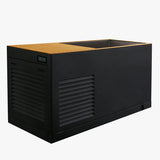
- Stainless steel (Revive Luxury Plunge): the coldest and most built, with an insulated steel tub, an aluminum exterior and casters. 72 in long, 37.8 in tall, 360 lb. For a garage, patio or home gym, used every day.
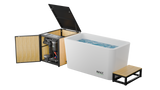
- Acrylic (Revive Acrylic Plunge, RevX Acrylic X): a spa-like finish and hot and cold in one. The RevX tub stands over 34 in tall for a deep, shoulder-high plunge, with jets and a 1.5 HP chiller.
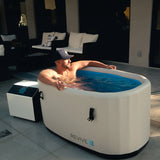
- Inflatable (Revive Inflatable and Barrel): a full plunge with no installation. Sets up in about 15 minutes and moves when you do. The barrel takes a footprint barely bigger than a chair, 31.5 in across.
The chilled plunges we carry list between about $2,500 and $11,000.
What power and space does a cold plunge need?
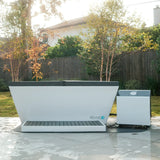
The Revive and RevX plunges run on household 120V power, and each maker asks for a dedicated 15A circuit. None of them needs plumbing: you fill it with a garden hose and the system runs as a closed loop. If you need a new circuit, our guide to what a home sauna really costs covers the electrical work.
Plan the floor for the weight: about 110 gallons of water weighs over 900 pounds, plus the tub. A garage slab, a patio or a ground-floor room handles it easily; on an upper floor or a deck, ask a contractor. Leave room around the chiller for air to move, and keep a towel and a mat within reach.
How do people use a cold plunge?
Most start with one to three minutes, a few degrees warmer than the coldest setting, and breathe slowly. Many pair it with a sauna: heat, then cold, then rest, for two or three rounds. Our guide to choosing a sauna and cold plunge set covers the routine.
Timing matters if you lift. A study of regular cold immersion right after strength training found smaller gains in muscle size and strength than active recovery over 12 weeks (Roberts and colleagues, 2015). If building muscle is your goal, keep the plunge away from strength sessions; after endurance work or on rest days, it fits well.
Many people say the cold leaves them awake and clear-headed. In one small study, an hour of head-out immersion at 14°C (57°F) raised blood noradrenaline and dopamine well above resting levels (Šrámek and colleagues, 2000). It is one study of a long immersion, so treat it as a clue, not a promise.
What upkeep does a cold plunge need?
Keep the cover on, rinse the filter as the manual says, and let the built-in sanitation (ozone on every Revive and RevX plunge, plus UV on some) do its work. Shower before you step in and the water stays clear far longer.
Sources
- Machado AF, et al. Can water temperature and immersion time influence the effect of cold water immersion on muscle soreness? A systematic review and meta-analysis. Sports Medicine, 2016. PubMed
- Roberts LA, et al. Post-exercise cold water immersion attenuates acute anabolic signalling and long-term adaptations in muscle to strength training. Journal of Physiology, 2015. Full text
- Šrámek P, et al. Human physiological responses to immersion into water of different temperatures. European Journal of Applied Physiology, 2000. DOI
- Temperatures, chillers, sizes, weights and power: each maker's specifications on our product pages, read November 11, 2026.
For adults. Check with your doctor before starting any heat or cold routine. General wellness information, not medical advice. The published research on heat and cold is on our research and sources page.
Written by Julie Myers and the Elysiums Luxe team. Specs and prices come from each maker and our live product pages, checked on the date above.